HSRs are not Union Reps: Clearing the confusion

admin • November 24, 2025

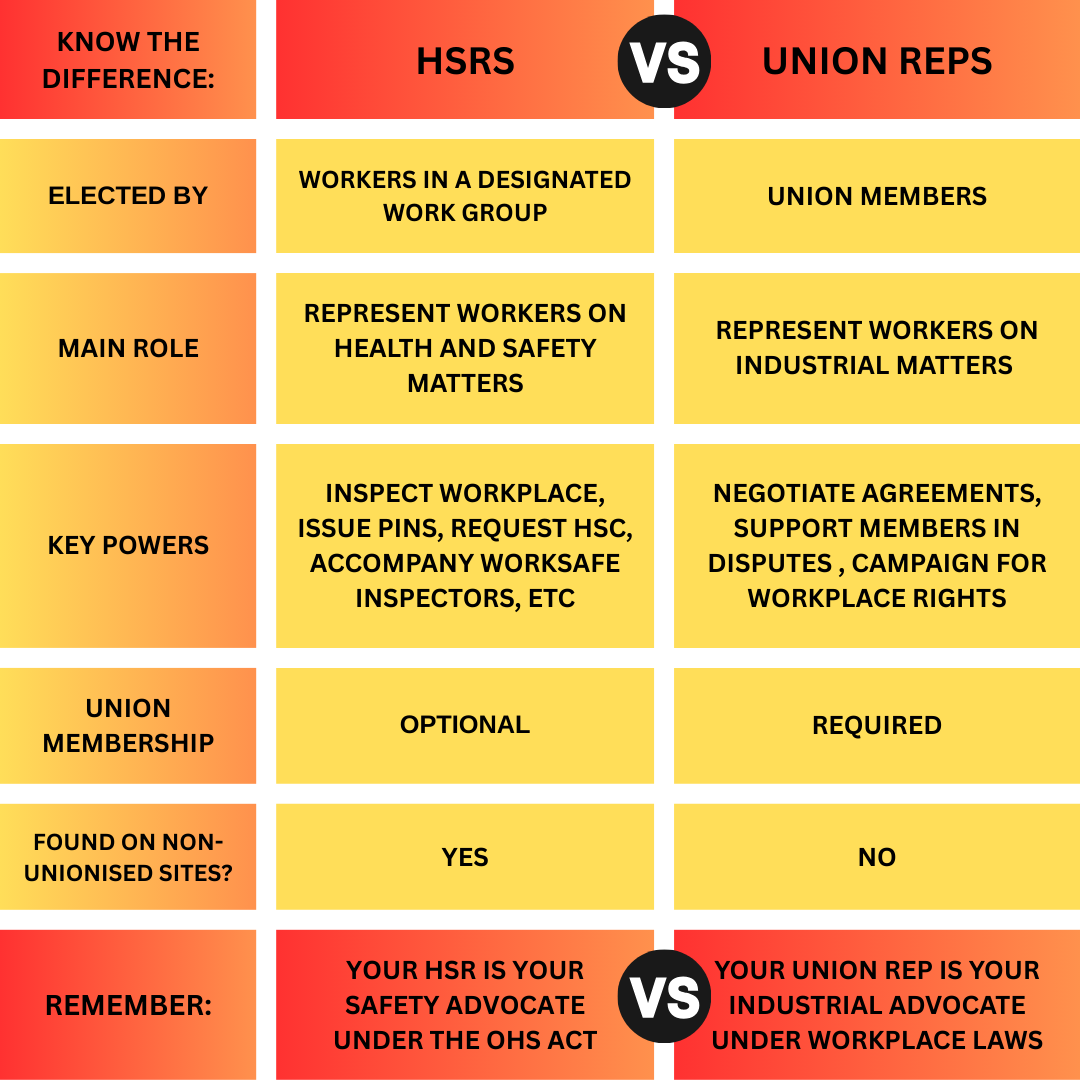
When it comes to workplace safety, one role often misunderstood is that of the Health and Safety Representative (HSR). Many people assume HSRs are the same as union representatives — but that’s not the case. While both roles aim to protect workers’ interests, their focus, powers, and responsibilities are quite different.


What Is an HSR?

An HSR is a worker elected by their peers to represent their health and safety interests. They are chosen from within a designated work group and act as a direct link between workers and management on safety matters.

Under the Occupational Health and Safety Act 2004 (Vic), HSRs have specific powers, such as:

  • Inspecting the workplace for hazards.
  • Accompanying WorkSafe inspectors during visits.
  • Requesting the formation of a health and safety committee.
  • Issuing Provisional Improvement Notices (PINs)

Importantly, HSRs do not negotiate pay, conditions, or other industrial matters — their role is purely about health and safety.


How They Differ from Union Representatives

Union representatives (or delegates) are appointed or elected to represent workers on a wide range of workplace issues, including wages, rosters, and employment conditions. They may also support members in disputes or negotiations with employers.

While an HSR can be a union member — and unions often provide training and support to HSRs — the position itself is independent of union affiliation. You don’t need to be in a union to be elected as an HSR, and you don’t automatically become a union rep by taking on the role.


Why the Distinction Matters

Confusing the two roles can lead to misunderstandings in the workplace. For example:

  • Employers might wrongly assume HSRs are pushing a union agenda, when in fact they are fulfilling legal safety duties.
  • Workers might hesitate to raise safety concerns with an HSR if they are not themselves a union member, due to confusion about their role.

By recognising that HSRs are safety advocates, not industrial negotiators, workplaces can foster more open, constructive conversations about keeping everyone safe.


Bottom line:

In Victoria, HSRs are there to represent their co-workers on OHS matters, helping to make sure your workplace is safe. Whether you’re in a union or not, you can elect an HSR. This is a key way to ensure that consultation is occurring and that you have a conduit through which to raise health and safety concerns.


Remember:
HSRs = Safety advocates under the OHS Act.
Union Reps = Industrial advocates under workplace laws.


So, it is important to know that you can (and have a legislated right to) elect an HSR at your workplace whether or not you work in a unionised workplace. All workplaces will benefit from having elected HSRs and safety structures in place – AND this has been proven to result in safer workplaces.


Not sure how to elect an HSR? Reach out to us at admin@besafevictoria.com.au

By admin December 15, 2025
Snakes are a natural part of the Australian environment, but when they enter worksites, they can pose significant risks. Snakes are most commonly encountered in industries such as construction and agriculture, but snakes can appear in any workplace – including in offices, warehouses, outdoor work areas, or storage spaces. Warm weather increases snake activity, making encounters more likely during summer months. The danger presented by snakes is very real, as snakebites can cause serious injury or death. Common Risk Factors There are certain workplace conditions which increase the likelihood of snakes appearing: Vacant sites : Snakes often move into quiet areas during holiday breaks or weekends. Shelter opportunities : Stored materials, rubble, sheds, and equipment provide dark, cool hiding spots. Food sources : Mice, frogs, and other small animals attract snakes to worksites. Hot weather : Snakes become bolder and more active in summer. Prevention Strategies As always, employers are required to reduce risks to health and safety in the workplace. They can do this by adopting proactive measures: Site housekeeping : Remove rubbish, debris, and unused materials where snakes could hide. Control food sources : Limit rodent and frog populations by managing waste and water. Protective gear : Wear gloves, boots and long pants when working outside or handling stored materials. Awareness training : Inform workers about snake risks, especially after site closures or during hot weather. First Aid training: ensure staff are trained in the initial response in the case of a bite. If a snake is seen in the workplace One of the most important safety messages is never provoke a snake. Most bites occur when people attempt to attack or handle snakes. If a snake is sighted: Stop work in the area immediately. Report the sighting to supervisors. Contact local authorities or licensed snake catchers to remove the hazard. First Aid for Snake Bites Your workplace should have a trained First Aider. The initial first aid for a bite should include: Lie the person down and keep them still. Applying a broad, firm bandage around the bitten limb, about as tightly as for a sprained ankle. Bandage over the bite site first and then bandage as much of the limb as possible, starting from below upwards. Keep the victim still and calm and splint the limb if possible. Do not cut, wash, or apply a tourniquet to the bite. Access immediate medical care - dial 000. Don’t forget that you will need to complete an incident report after a snake bite has occurred. Then, your risk management follow up processes should be followed. A snake bite may be classified as a notifiable incident, in which case it must be reported to WorkSafe Victoria – call 13 23 60 . Conclusion Snakes are a real workplace hazard , especially in construction, agriculture, and outdoor industries. If your workplace is high risk for snakes then you are required to control the risk of snake bite. Prevention and awareness are the best defence: keep sites clean, reduce food sources, and train workers. Never provoke a snake —leave removal to professionals. First aid knowledge can save lives in the event of a bite. By treating snakes as a legitimate occupational hazard, workplaces can protect their workers from a potentially fatal hazard. For more information, see the following resources: Snakes at work: why you should never handle one yourself | WorkSafe.qld.gov.au Snakes on sites - OHS Reps Notifiable incidents under the Occupational Health and Safety Act 2004 | WorkSafe Victoria https://stjohn.org.au/app/uploads/2025/08/Fact-sheets_snake-bite.pdf
By admin December 15, 2025
Sun exposure is one of the most underestimated workplace hazards, especially for outdoor workers. Prolonged exposure to ultraviolet (UV) radiation can cause serious health risks, but with the right protections, employers and employees can reduce these dangers. Why Sun Exposure is a Workplace Hazard UV radiation risk : Outdoor workers are exposed to UV radiation for long periods, which can lead to skin damage, sunburn, premature aging, and skin cancers. Eye health : UV rays can also damage the eyes, increasing the risk of cataracts and other vision problems. Heat stress : Extended time in the sun raises the risk of dehydration, heat exhaustion, and heatstroke, which can impair concentration and increase accident risks. Cumulative exposure : Unlike a one-time hazard, UV damage builds up over years, making outdoor workers particularly vulnerable. Employer Responsibilities The legislation prescribes that employers must provide a safe workplace that is without risks to health and safety. As such, employers must take steps to eliminate or reduce UV exposure risks so far as is reasonably practicable . This includes: Risk assessment : Identifying tasks and times of day when UV exposure is highest. Protective measures : Providing shade structures, scheduling work outside peak UV hours (10 am–3 pm), and rotating tasks to limit exposure. Education : Training workers on the dangers of UV radiation and how to protect themselves. Policy implementation : Establishing sun protection policies as part of workplace health and safety systems. Monitoring conditions : Being aware of UV index levels and reporting unsafe conditions. Consulting with employees : in relation to the hazard of sun exposure. Worker Responsibilities Under the OHS Act, employees have a duty to take reasonable care of their own, and others, health and safety and to co-operate with measures taken by their employer to ensure health and safety. Employees can play a role in protecting themselves by, for example: Wearing protective clothing : Long-sleeved shirts, wide-brimmed hats, and sunglasses with UV protection. Applying sunscreen : Broad-spectrum SPF 30+ sunscreen should be applied regularly throughout the day. Hydration : Drinking water frequently to prevent heat stress. Monitoring and reporting: Being aware of UV index levels and reporting unsafe conditions. Building a Sun-Safe Workplace Culture Creating a workplace culture that prioritizes sun safety is essential. This means: Normalising sunscreen use and reapplication breaks. Encouraging workers to look out for each other’s wellbeing. Making protective gear accessible and mandatory. Recognising that sun protection is not just a personal choice but a workplace safety requirement. Key Takeaways Sun exposure is a serious occupational hazard for outdoor workers. Employers must provide protections such as shade, scheduling, and training. Workers must take proactive steps like wearing protective clothing and using sunscreen. A strong workplace culture around sun safety reduces risks and promotes long-term health. Sunlight is vital for life, but in the workplace, it must be managed like any other hazard. Hazard identification and risk control is a legal requirement under the OHS Act. By treating UV exposure with the same seriousness as machinery or chemicals, employers and workers can ensure safer, healthier outdoor environments. For more guidance in relation to this: Sun protection for outdoor workers | WorkSafe Victoria