International Workers Memorial Day

admin • May 5, 2026

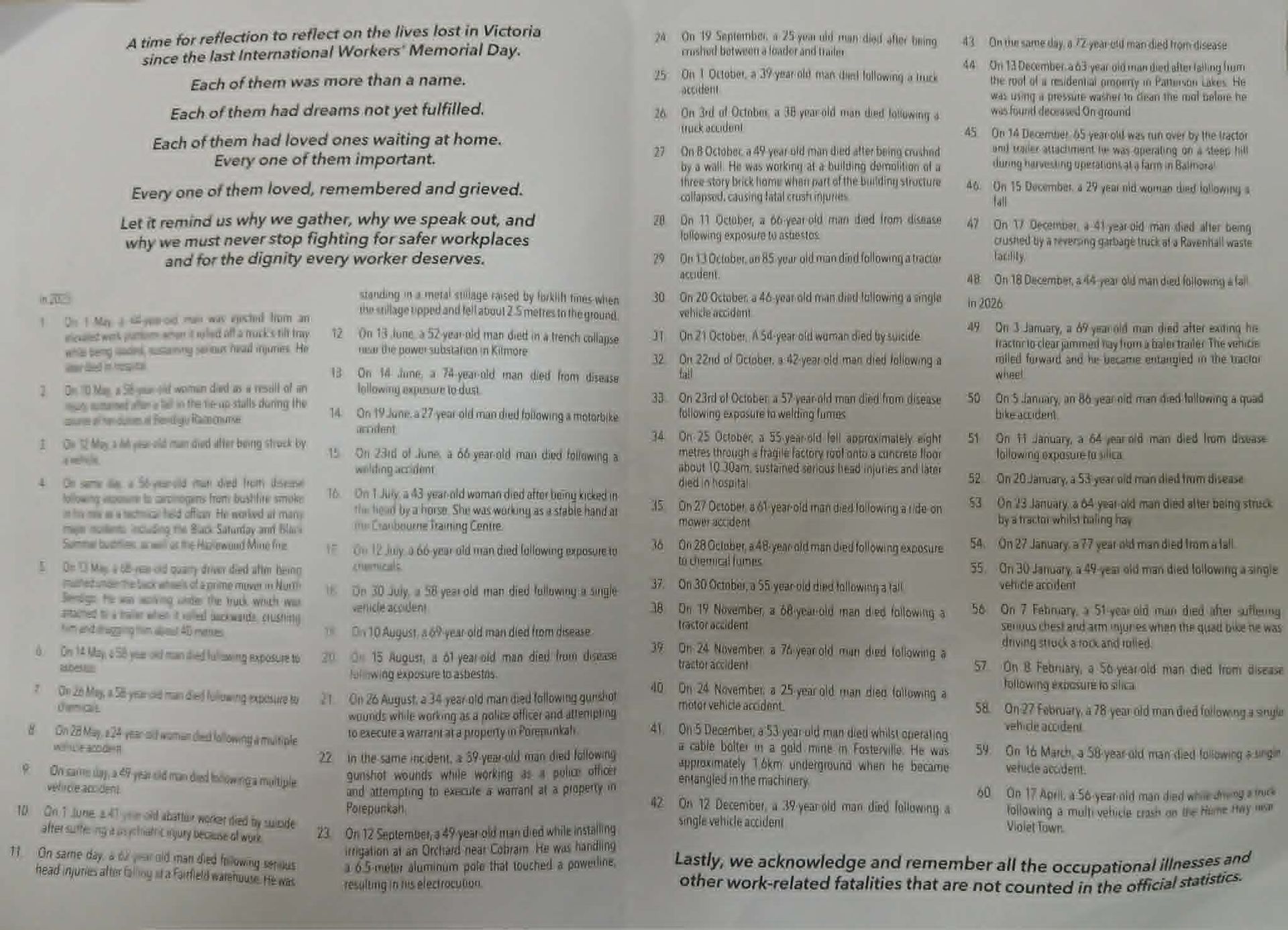
On 28 April 2026, BeSafe joined those gathered at Argyle Square, Carlton, to mark International Workers’ Memorial Day (IWMD) in Melbourne. The ceremony honoured those who have lost their lives due to workplace injury or illness and renewed a shared commitment to safer, healthier workplaces.


The service began with speeches made by The Secretary of Victorian Trades Hall Council (VTHC) Luke Hilikari, Premier Jacinta Allen, WorkSafe CEO Cathy Henderson and Lived Experience Advocate Lana Cormie. Assistant Secretary of VTHC Wil Stracke was the MC for the occasion and the Trade Union Choir sang throughout. The most moving part of the service was, as always, the boot laying ceremony. This year, 60 pairs of boots were laid to represent the workers lost in the past 12 months. Finally, a rose was laid to represent those who are not counted - in recognition that the numbers are vastly underestimated and many workplace deaths are not recorded in the official statistics.


The vision of 60 pairs of boots sitting upon stools in the park is profoundly tragic and deeply moving. A minutes silence marked the moment. This was followed by attendees laying wreaths to honour the fallen workers.


The speeches included messages of regret and sorrow, but also a call to action – as we can only truly honour the dead if we take action to ensure the safety of the workers of the future.


Honour the dead, and fight like hell for the living.”  


At BeSafe, we are passionate about workers’ safety and we will continue to do anything  we can to improve the safety of all Victorian workplaces.


For more on this:

Strong union message at workers’ memorial — Independent Education Union Victoria Tasmania

STRONG MESSAGE TO COMMEMORATE FALLEN WORKERS ON IWMD - OHS Reps

By admin June 29, 2026
Today is the anniversary of the banning of Engineered Stone. On the 1 st July 2024, Engineered Stone was banned due to the high levels of silica it contained, which presented a health and safety risk to those working with it. The banning of engineered stone is a huge win for the safety and health of workers, but it does not mean that workers are safe from silica related disease. Workers can still be exposed to silica from other sources, including: Stone Asphalt Cement, mortar and grout Concrete, concrete blocks and cement products Bricks and pavers Tiles Sand These and related products still present a risk and this comes in the form of respirable crystalline silica. Small particles of silica can be produced when dust is produces through cutting, sanding or processing the materials. This can occur during manufacturing and construction, when mining or digging, and when handling waste. The silica dust can be breathed deep into the lungs and can cause serious disease., including silicosis, fibrosis, COPD, bronchitis and lung cancer. In addition, it can cause other systemic diseases including serious effects on the kidneys, immune system, eyes, etc. Employers must control the risk of exposure and workers should be aware of the risks so that they can make sure that they are safe. BeSafe is still horrified to occasionally see dry cutting by workers who may not be aware of the serious risks of this practice. Just remember, that just because engineered stone has been banned, it doesn’t mean you are safe from silica related disease. Make sure you know how to protect yourself and stay safe from this serious and deadly hazard. More information: For the general information page with resources relating to crystalline silica, take a look at: Crystalline silica | WorkSafe Victoria For information relating to how employers must identify hazards, assess risk, control the risk and review and revise controls regularly, take a look at: Preparing a crystalline silica hazard control statement for high-risk crystalline silica work | WorkSafe Victoria For a practical guide on how to safely work with engineered stone, including exemptions, take a look at Compliance code: Engineered stone | WorkSafe Victoria
By admin June 15, 2026
Welding fumes are hazardous, and employers must control the risk of harm. Various types of welding are used in the workplace, with varying levels of welding fume production. The amount and type of fumes produced during welding will vary based on various factors including: the metals being welded, the welding process used, the composition of the welding rod/wire, the shielding gases used and any contaminants or coating on the metal, etc. There are a number of health effects which may occur due to exposure to welding fumes. These include both short-term and long-term affects Short term: eye irritation, respiratory irritation, metal fume fever (zinc oxide). Long term: siderosis (iron accumulation in the body), lung and kidney cancer, nervous system disorders, asthma, pneumonia. The likelihood of developing damaging health effects from welding will depend on the type of welding being used (and therefore the type of fumes produced), the duration and frequency of exposure, the worker’s proximity to the fumes, the ventilation of the welding area, and any controls which were utilised during the exposure. Welding fumes are a hazardous substance and must be controlled according to the hierarchy of controls. Controls may include: Eliminating the need for welding if possible, for example by using different fastening methods or prefabricated components. Substituting the welding method, for example by using a method which generates less fumes, or using automation methods. Engineering controls including mechanical ventilation such as on-torch extraction or local exhaust ventilation. PPE should be provided by the workplace and includes the use of air fed ventilators. The use of respirators such as Powered Air Purifying Respirators can be used but only in addition to a higher-order control, or if higher-order controls are not possible. Other types of respirators are available but less effective. Several different controls may need to be used and as with any controls, training must be provided on their implementation. Atmospheric monitoring may also be required to monitor exposure levels in the workplace and health monitoring must also be carried out in accordance with the OHS Regulations 2017 Part 4.1 - Hazardous Substances.  Consultation with the workforce, including any elected health and safety representatives, must take place in accordance with requirements under the Occupational Health and Safety Act 2004. For more information on welding fumes, take a look at the following links: https://youtu.be/0tvrOw18Vr0?si=oK_v3vkbGebCzuMf Controlling exposure to welding fumes | WorkSafe Victoria Compliance code: Hazardous substances | WorkSafe Victoria - Welding fumes | Safe Work Australia